
Ishak Paşa Palace, East Turkey
The Doğubeyazıt district in the Ağrı Province - one of the easternmost settlements in Eastern Anatolia - is the small town which is the base for visiting the absolute splendour that is Ishak Paşa Sarayı (Ishak Pasha Palace).

The real urge for us to see Ishak Paşa Sarayı came when we were watching the 2006 Nuri Bilge Ceylan film, İklimler (Climates).
In the film, he takes a taxi in the snow to the palace to take some photos.
If you know of Nuri Bilge Ceylan, you'll know he's also a fantastic photographer as well as cinematographer. So you can just imagine this lonely mountain-top palace and the desolate valley below, covered with snow.
It became one of those enduring we've-got-to-go-there moments.
Coming Face To Face With Ishak Pasha Palace
And then a visit to friends in the area, and a subsequent self-drive road trip around the easternmost provinces of Eastern Anatolia, finally gave us the opportunity to soak up the unique experience of visiting Ishak Pasha Palace.
The mystical became the real - and 'the real' didn't disappoint. Far from it!
We were doing an east Turkey road trip. So close to the Iranian border were we that road signs pointed us to Doğubeyazıt - Kars - Iran. We shared the lonely roads with lorries displaying Iranian number plates.
A whole world away from from our Mediterranean life in Fethiye.
Navigation
On reaching Doğubeyazıt, road signs for the palace were not immediately obvious - this area didn't attract many tourists at the time. But we knew we needed to head uphill, so we chose the winding hilly road that lead us out of town...

If you ever find yourself in this area of eastern Turkey, please don't miss out on Ishak Pasha Palace.
This place is magical scenic bliss.
Ishak Pasha Palace - Surrounding Area
The photo above is taken from the car park in front of the palace. And, as you can see, the road continues to wind uphill amongst rugged mountains.
Three further sites of historic interest lie in this immediate surrounding area - all part of the old settlement.
We knew the views from further up this hill are even more breathtaking than the ones we could see behind us. But on this day, we weren't allowed to go any further up the hill because a funeral was taking place, so there was a sizeable Jandarma presence.
But this is the type of scenery that makes you feel small and insignificant and in awe of the world.
These were the scenes we wanted to see for ourselves.
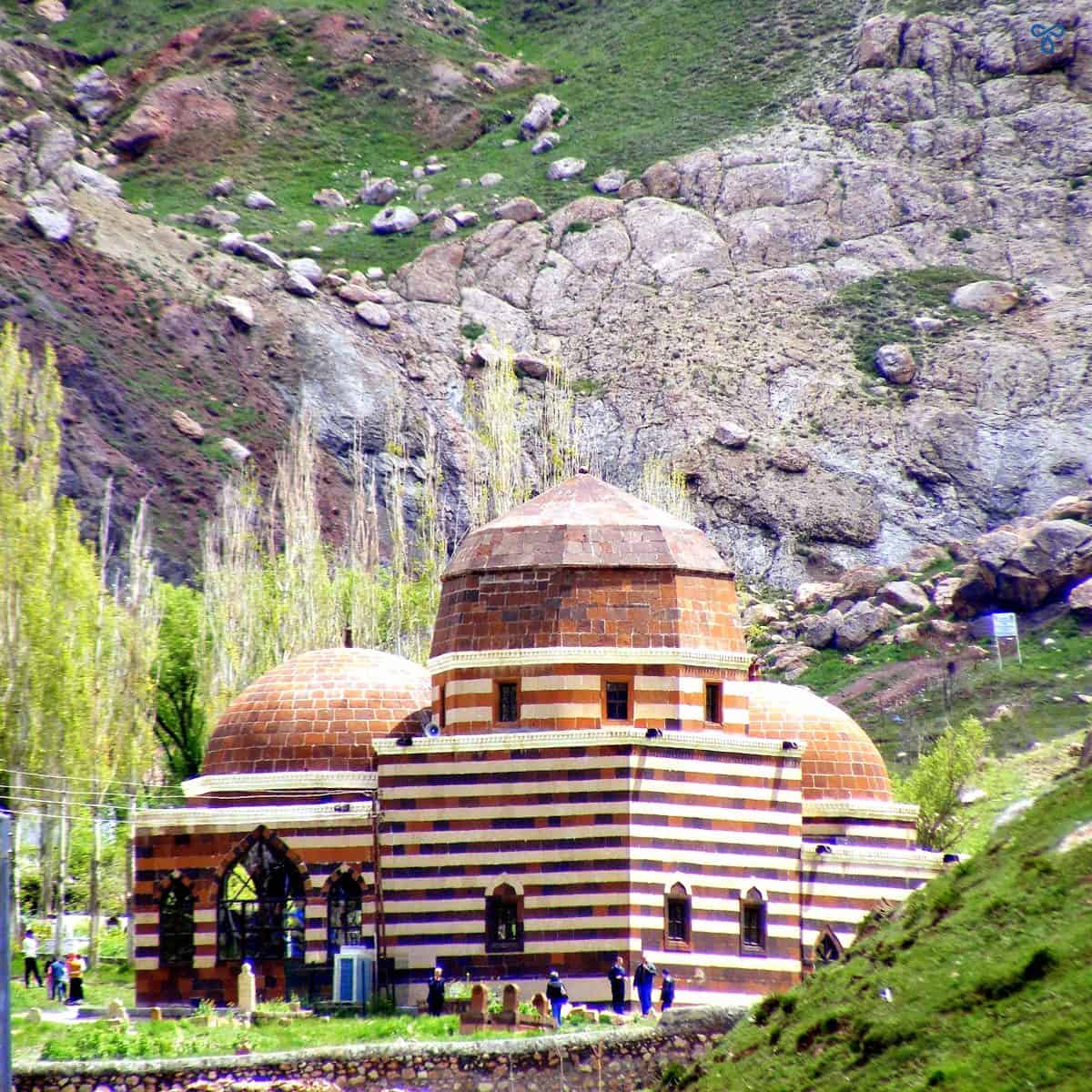
Grand Tomb
Camera zoom lens had to come into play for photographing the Grand Tomb - the tomb of Ahmed-i Hani.
Born in 1651 in Cizre or Hakkari - the cultural centre of the area at that time - he was a prominent poet, writer, astronomer and philosopher who also studied Arabic.
This was a man well-travelled and who clearly had some standing in this area, judging by his tomb.
Interestingly, considering he was such a prominent figure, his date of death is uncertain.
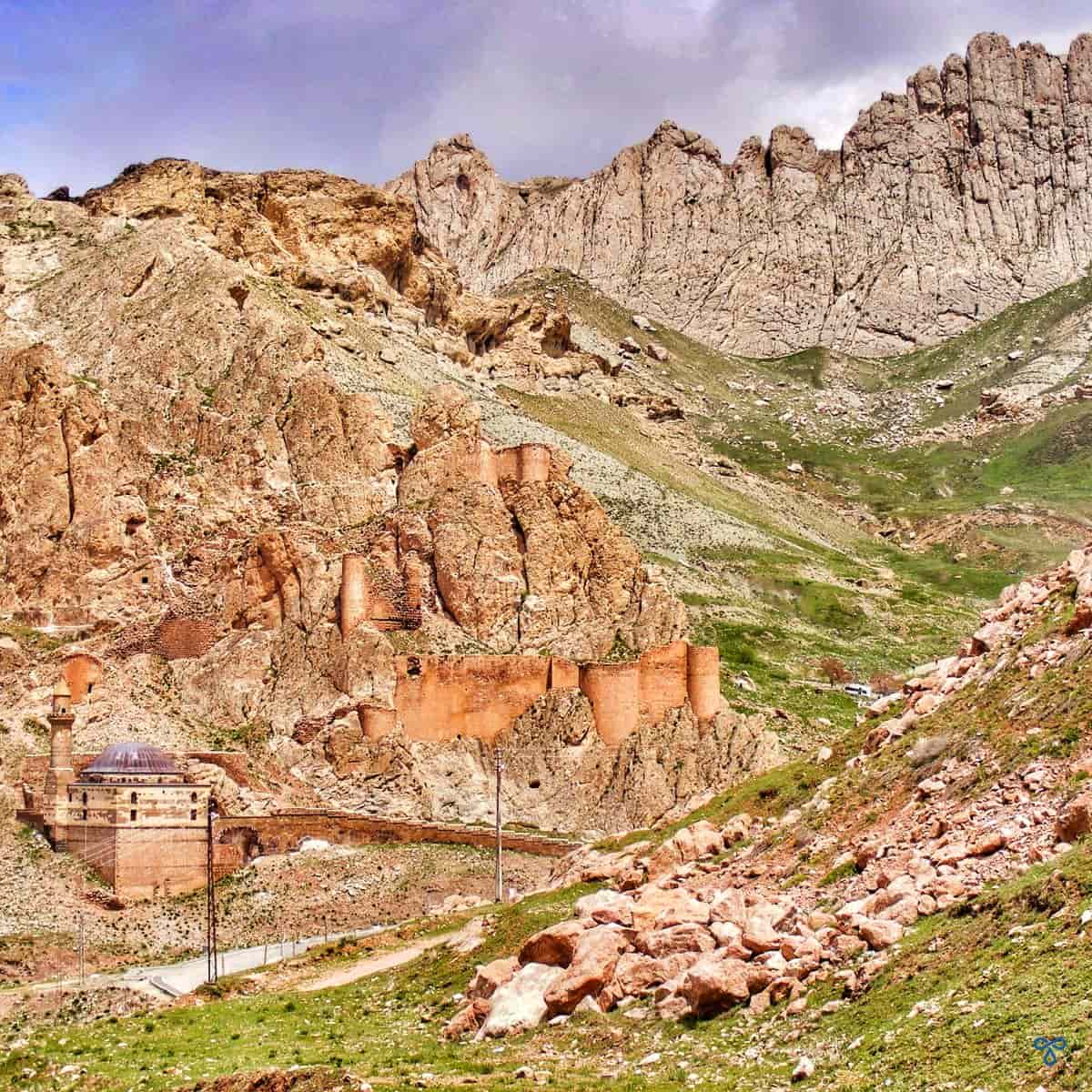
And on the opposite side of the road, almost camouflaged against the steep rock face, stands the old Doğubeyazıt mosque and the ruins of the Doğubeyazıt Castle.
Due to sheer distance from any settlements, these days, the mosque no longer serves anyone.
And whilst it is unclear when the castle was built, an embossed grave reveals Urartu work - a kingdom which existed in the Iron Age from the 9th to the 6th Century BC.
As is evident from the castle walls, the Urartians were well-known for their large fortresses. And also their sophisticated metal work.
Exploring Ishak Pasha Palace
We'd seen so many photos of this lonely palace resting on the side of a mountain, overlooking the plains and the town of Doğubeyazit below. Plus the majesty and shadow of Mount Ararat (Ağrı Dağı) looming in the distance.
Just amazing!
But now time to head through the imposing main gate to get up close and personal with the historic stone walls of the palace...
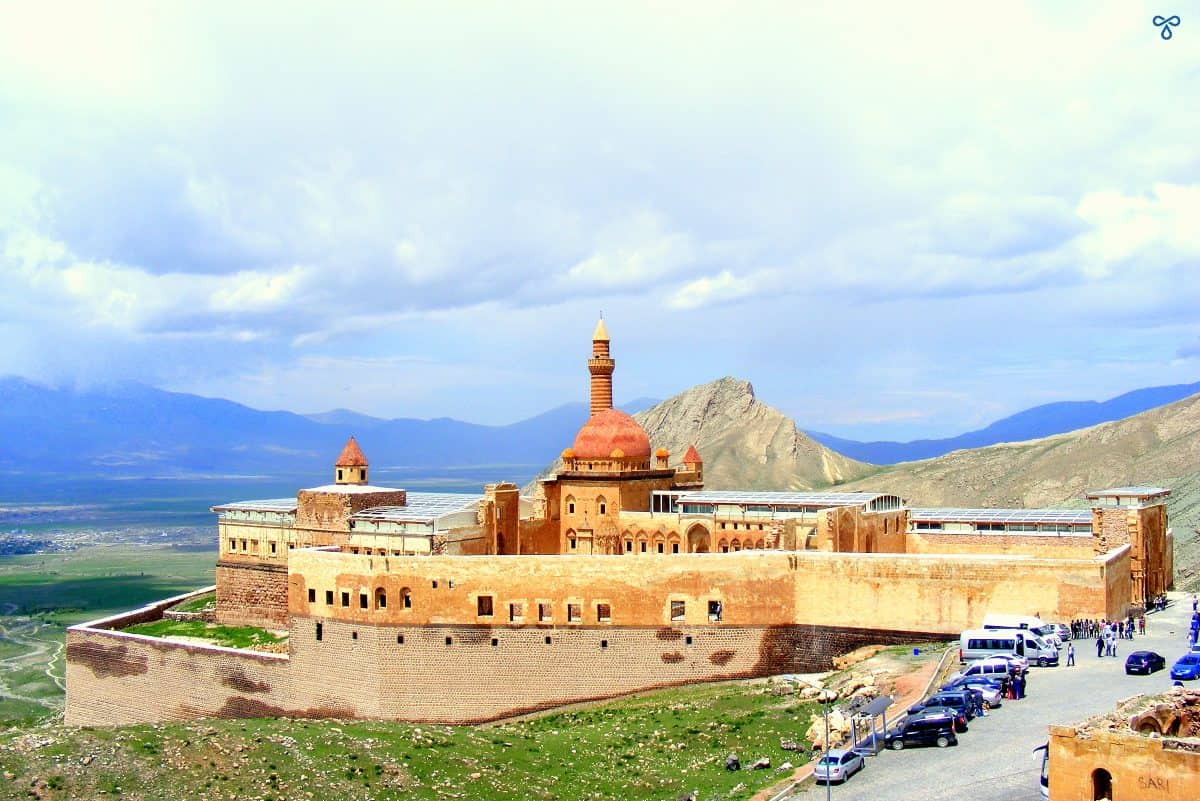
We're on the Silk Road, here, 2000 metres above sea level. Were it not for the car park, we could feel ourselves back in the 18th Century when the palace was completed.
Inside the walls, the palace feels other-worldly.
Whilst the buildings of the first courtyard - where it is thought guests stayed with their camels - are largely destroyed, there's lots to lose yourself with in the second courtyard of the palace.
Selcuk Mausoleum
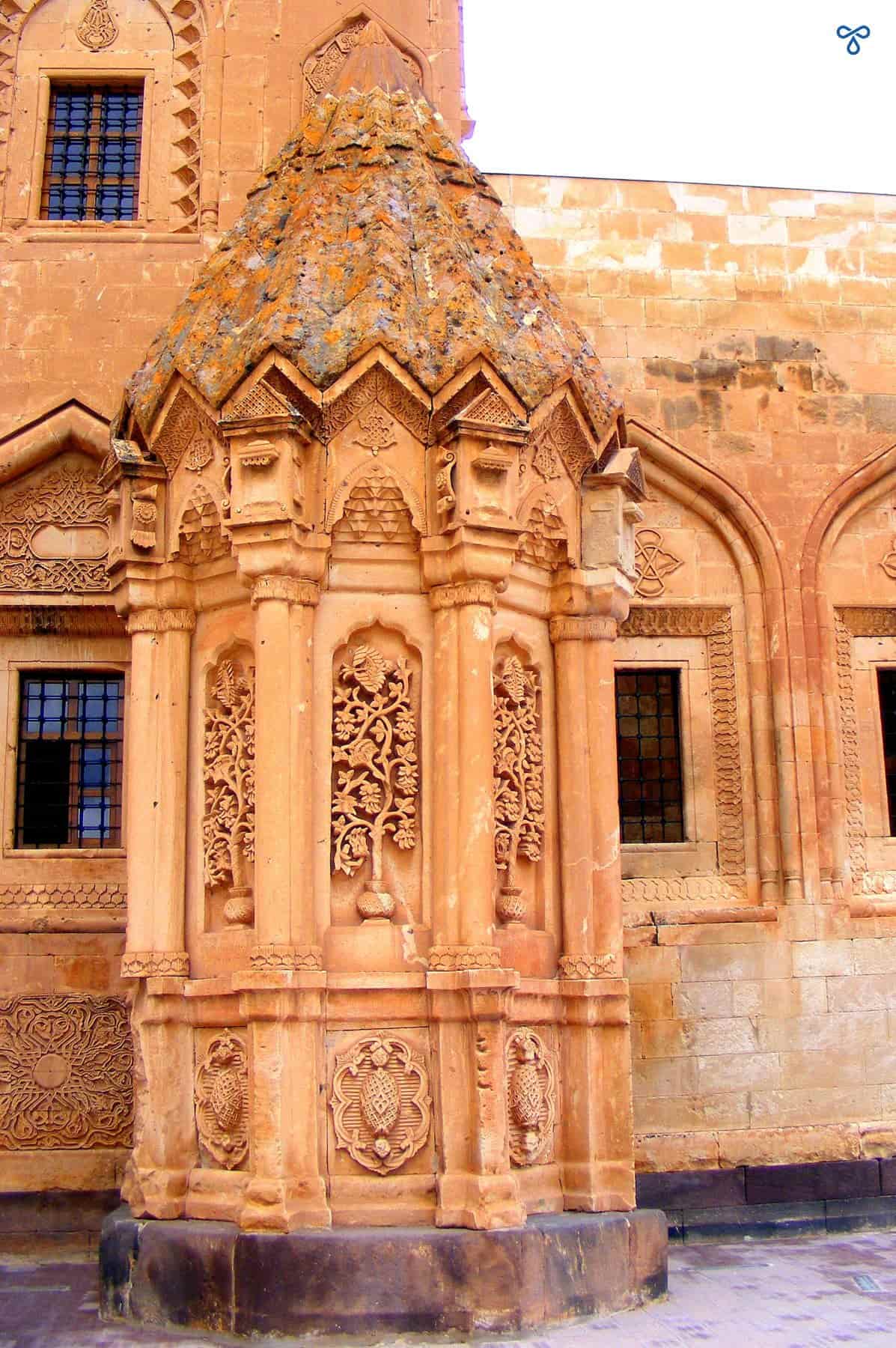
There was just a smattering of visitors on the day we were there. So it was perfectly easy to lose yourself in the architecture and the geometric motifs of the stonework.
You can't miss the octagonal Seljuk mausoleum in this second courtyard.
This is the mausoleum of Çolak Abdi Paşa of the Çıldıroğulları and his close kin.
He started the construction of Ishak Pasha Palace in 1685. But it would be 1784 before Ishak Paşa II, a descendant of Çolak Abdi Pasha, would complete it.
21st Century & UNESCO
The 21st Century was evident as we explored the semi-ruined palace with its various architectural styles.
The palace is unique in combining both Seljuk and Ottoman style and we have Baroque, Rococo and Persian artistic features.

The neat stone workmanship - stone taken from the surrounding areas - in Ishak Pasha Palace is fascinating.
To protect all of this, a glass roof covers different sections of the palace.
As with any modern day protection of archaeological sites, this caused some controversy.
In 2025, it was announced that plans were underway to make a bid to elevate Ishak Pasha Palace from the Tentative List to full recognition as a UNESCO World Heritage Site.
The good news for the palace and its future is that this means site management plans and plans for site preservation and sustainable tourism must be first put in place.
Doorways
The second courtyard has some gloriously ornate stonework on show around doorways to significant areas of the palace complex.
This doorway marks the entrance to the selamlik.

The 'selamlik' was the men's quarter and the area where guests were received and entertained.
And at the far end of the courtyard is the beautiful entrance to the harem section of the palace.

Entering the harem here is a whole world away from the simultaneous feelings of claustrophobia and enchantment when entering the secretive, thick tiled walls of the harem at Topkapı Palace in Istanbul.
Originally, the doors at the entrance of the harem were plated with gold. But it is said these doors were taken by the Russians during a siege in the Russo-Ottoman war in 1828.
Guest Rooms
The guest rooms in the palace are identical. They all feature two small windows looking out onto the mountainous landscape surrounding the palace with a stone fireplace separating them.

As well as the stone hearths, Ishak Pasha Palace is unique because it had a central heating system which is documented as one of the first of its kind in the whole world.
Cavities in the walls of these rooms indicated to archaeologists the presence of this heating system.
It's no wonder the engineers of the time got so creative as to invent a central heating system.
It was mid May when we were in the area. And, despite the presence of spring wildflowers, there was still an abundance of snow around the mountaintops. The winters around these parts are brutal!
Some Colour
Much of Ishak Pasha Palace is the sandy stone colours you can see in the images above. But there is a bit of colour here and there.

The outside of the dome of the mosque is an earthy red whilst inside, it is painted with floral motifs.
Since our visit, the stone floor of the mosque has been carpeted, so you will need to remove your shoes to visit this part of the palace.

And not so much colour but rather, contrast, in what was labelled on the wall as the 'dining room' of the palace.
This was the ceremonial hall where dining and entertainment took place. Its walls are decorated with verses from the Quran and a couplet which indicated the palace was completed in 1784 AD.
And Those Stupendous Views

We were a group of 7 friends exploring Ishak Pasha Palace. And it's fair to say we were all mesmerised by the place.
I spotted a room which looked like it might have amazing views of the plains below. Well, yes it does. As you can see in the photo above.
Mount Ararat wrapped in cloud in the distance, Doğubeyazıt down below, spring flowers creeping over the near mountainside...and a sheer drop!
This is the 'Terrace' and it exited straight from this ledge with a dizzying drop, hundreds of metres below.
Nothing at all to stop any of us tumbling downwards into the abyss! Ishak Pasha Palace is built onto a steep valley slope - and the valley slopes dramatically downwards, here.
You'll be pleased to know, a bit of scouring around online and it looks as though someone has seen fit to place barriers here, now.
Safety ponders aside, this is my favourite memory of Ishak Paşa Sarayı.
This was the scenery we came up here to see. And it didn't disappoint.
Eventually, hunger beat us all. We headed off back down the hill, 5 kilometres, into town and another unexpected treat. We stumble across a lokanta that recommends we try the local speciality, Doğubeyazıt Köftesi.
Ishak Pasha Palace, East Turkey - Useful Info
- Entrance fee to the palace (November 2025) is 3 Euros for adults, regardless of nationality. All official Turkish museum and palace entry fees are now in Euros and you can check the latest price here. Children 0-8 who are non-Turkish citizens enter for free.
- If you aren't driving, there is a dolmuş that comes up here from Doğubeyazıt. Taxis will also run you up here and wait for you for an arranged fee.
- The palace was completed in 1784 by Ishak Paşa - and architecture and art history enthusiasts will find a mixture of Mesopotamian, Anatolian and Persian styles. It is the last major monumental structure of the Ottoman period in the Tulip Era (Lale Devri).
Amazing - difficult to imagine we are living in the same country.
Yeah, certainly this area of East Turkey is another world. Want to see more. 🙂
Breathtaking photos, such a fascinating place, I was at Ishak Pasa a long time ago, this brings fond memories, thank you!
Just loved it up here and there are so many photo opportunities around Doğubeyazıt. Glad it brought back fond memories. 🙂