
Mastering Turkish Rice: Tips from Our Kitchen
Turkish rice (şehriyeli pilav) - definitely one of the most famous dishes in Turkey!
If you're familiar with Turkish food, you'll know that rice features quite heavily in the eating process. A lot of Turkish recipes end with, 'serve with rice'.
If you go to a lokanta (a type of Turkish restaurant), whichever dish you choose from the bain marie, it's highly likely that you'll be asked whether you would like a side serving of rice to go with it.
The rice is never on the same plate; pilav is a dish in itself and is served separately.
As soon as we moved to Turkey, we were keen to get our hands on an authentic Turkish rice recipe!

Tasty Fluffy Rice
Thankfully, Turkish rice is very tasty.
It's rich and buttery and is indeed delicious on its own. Or with a good bowl of natural yoghurt on the side, too.
Whenever our friends come to Fethiye to visit us, they always say, 'I can't wait to have some Turkish rice'.
It's a staple side serving in most restaurants. So it's a dish holidaymakers become familiar with straight away.
One of our Turkish friends is an amazing cook (and loves to cook). But her husband says he's happy just eating Turkish rice with yoghurt.
Whilst this makes her mad, it's surely a good example of how rice is much-loved by many in Turkey. Even if it does drive our friend round the bend!
So, it was becoming increasingly difficult to live in Fethiye and not be able to produce a good bowl of Turkish rice for the table whenever we had friends round for dinner.
One night, when we were round at another friend's house for food, we stood watch in the kitchen as she prepared different dishes.
We studied her method for how to make Turkish rice - the Turkish way!
Since that time we've followed and adapted her methods to make our own version of the recipe work for us.
This is now our tried and trusted method which gives us the best results.
Turkish Rice - About The Ingredients
Before moving to Turkey, we had no idea what şehriye was.
And, when we were in restaurants, eating meals, we always wondered what those 'golden brown bits' were in our servings.
Well, those 'brown bits' are orzo (şehriye) and are a type of pasta. As you can see in the photo below.
Some recipes will use vermicelli, instead. Both are quite common.

When you are sauteeing your orzo pasta (aka risoni), it's important that you keep a close eye on it. Once it starts to brown, it can burn very quickly.
That will ruin the flavour of your pilav dish. If you are using vermicelli, it will brown quicker.
Add your rice immediately after you notice the change in colour and keep stirring with a wooden spoon.

Baldo Pirinç
If you are in Turkey and you want to make this recipe, there are different varieties and types of rice you can buy to suit different purposes.
The best type to buy for şehriyeli pilav is a rice with grains of medium length, called Baldo Rice (Baldo Pirinç).

Our Turkish Rice Recipe
This is a quicker version to the completely traditional method of making şehriyeli pilav.
It's a method that works very well for us.
And, based on lots of feedback over the years, this recipe works for others, too.
This recipe makes enough pilav to serve as a side dish for four people.
Liquid To Rice Ratio
However much you decide to make, the easy thing to remember is you just use twice as much water as rice. If you do that, it should cook perfectly.
So, what about that traditional method we mentioned earlier?
Well, in Turkey, before cooking, people will rinse their rice thoroughly to get rid of all the starch so the rice doesn't become sticky.
Some people will also soak their rice in warm water before cooking.
Adjust & Experiment
If you want to cook rice pilaf in this way, you will need to alter cooking times. You will also need to adjust the amount of water or stock you use.
We tend to use chicken stock (chicken broth), but you can use whatever you have to hand.
It won't make too much difference to the overall taste of the finished dish.
It's all down to experimenting, as you will see in some of the comments below.
For us, the best type of rice for Turkish rice pilaf (by far) is Baldo - but other short-grain rice such as Arborio rice or basmati rice will do the trick. Shorter-grain rice has a high starch content, which helps it to cook up fluffy.
While it's not strictly essential (we've been guilty of skipping this step on occasion), some people say it can improve the finished dish if you wash the rice before cooking it.
Don't stir the rice too much while it is cooking, as that can make it a bit sticky. Also, we've found that it's a good idea to let your rice rest for a few minutes after it is cooked, before fluffing it with a fork.
Let's make rice pilaf...

Our Turkish Rice Recipe
Ingredients
- 1 cup rice (we use a standard tea/coffee mug)
- 2 tablespoons orzo (or şehriye or vermicelli)
- 1 tablespoon butter
- 2 cups hot water or stock (use same-sized cup you used to measure the rice)
Instructions
- Heat your butter in a deep saucepan over a low to medium heat.
- Now add your şehriye (orzo) to the pan and stir around for a few minutes until you see it start to change colour.
- As soon as you notice the orzo start to go brown, add your rice and continue to stir. Remember to keep the pan over a low heat and keep stirring, otherwise your rice and orzo will burn.
- After 3-4 minutes, add the water or stock.
- There will be a big sizzle and the liquid will bubble up. Turn up the heat and bring the rice to the boil, fully.
- Once the rice is boiling, give it a couple of stirs around, put a lid on the pan, leaving a small gap, and reduce the heat to medium-low.
- Leave your rice to simmer for 8-10 minutes until the water or stock has absorbed.
- Now remove from the heat, put the lid firmly on the pan and leave the rice to stand for 5 minutes.
- After 5 minutes, remove the lid and fork through your rice.
Notes
- If you find the butter too rich in your Turkish rice, we sometimes just use a glug of olive oil or vegetable oil. This is not traditional and does change the flavour slightly but it makes for an occasional, tasty variation.
- Whatever size cup you use for your rice, make sure you use the same for your water or stock.
- Calories are approximate and are calculated on using butter and water as opposed to stock.
Nutrition
Now that you know how to make Turkish rice, why not get some ideas about all of the different sorts of Turkish dishes you can serve with it?
And, if for some reason you aren't a huge fan of rice, then really good alternative Turkish side dishes you could serve up instead of this recipe include kısır, bulgur pilaf and green lentil salad.
If you've enjoyed this recipe, you may want to add us as a preferred source in Google which allows you to choose websites you like reading so you can see more of their content in search results and AI summaries.
Hi Julia,
What type of rice did you use here. It's definitely not basmati rice. Will jasmine rice work?
@ Kris: Glad it worked out well for you. We love all types of rice - but the right rice must go with the right meal. 🙂 Turkish rice is great for the type of foods you eat it with.
Just cooked this and it came out really delicious, just like the restaurants on Green Lanes in London.
Turkish rice is becoming one of my favourites, currently its second only to Indian, South East Asian and Middle Eastern rice!
@Kris, doesn't that make it fourth then?
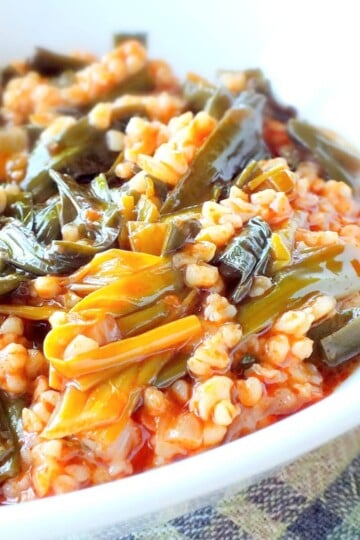
@ DubaiBee: I think the meal you're talking about is bulgur pilav. Cracked wheat. You can have it cooked plain like the rice (prepared in exactly the same way as this rice dish) but most places serve it in a tomato sauce. We've got a recipe for that, too, of course. 😉 Here's a link to our bulgur pilav recipe.
Hi Julia,
Just spent more time in Istanbul and this time we were served a delicious dish of what I can only guess was Barley created in the same way as your Pilav rice. The restaurant is an old 'original' near the Fish Market of Istikaal street and it seemed pretty genuine in flavour and style. Any ideas on a recipe or how to prepare the dish (I assume it is different from Pilav preparation as Barley takes so much longer? It was rich, flavourful and 'creamy' in a rice/barley sort of sense). Thanks! Rachel
Interesting, Kuday. I've always been told by friends to use double the amount. I guess if they both work, it doesn't matter too much. I've never had any problems, using 2 mugs of water. I may try your method next time to compare. 🙂
The most important thing in the recipe is the ratio of rice and water: 1 mug of rice/1.5 mug of water. (Use the same mug!)
From my own experiences, i can say that even 2 mug of water is too much.
I found the same thing. Here’s my idea re that. My last home had gas stove and the 1:2ratio always worked. I now have an old electric stove and I’ve found i must use 1 cup rice to 1 1/2 water. I’m curious if anyone else noticed that.
hi Lynne, gas and electric heat are definitely different for cooking times. Also, the quality and the shape of the rice being used, too. these days, we're a ratio of (roughly) 1 3/4. We're never very careful with measurements. 🙂
@ Simcha: Thanks for your comment. Is your husband Turkish? Our Turkish friend's husband always wants to eat pilav (bulgur or rice) with yoghurt! 🙂
My husband wont eat rice unless it has şehriye in it. His favorites are the bulgur pilavs. He eats this with salad and yogurt.
Thanks. I quite like the look of the pilav in the bottom photo - don't think it's ever looked like that before! 🙂
Afiyet Olsun 🙂
Those Pilaf looks perfect
Connie, I do make pilav with butter sometimes - particularly if it's for other people but i think I must put too much in (for me anyway) because i can really taste it.
Natalie, I'm thinking it's been more good luck than good management with Turkish rice. I keep expecting the dreaded sticking to the pan but fingers crossed...So how often is hubby at this mother's then? 🙂
I have given up trying to cook Turkish rice. Always ended up with it stuck to the bottom of the pan or really soggy. Told hubby if he wants Turkish rice to go to his mothers!
Pilav is one of my favorites! Such a great addition to food! I also posted a recipe for pilav on my blog, but in the full Turkish style, heaping butter and all! =)
@ thebockster - Mmmm, I bet pide and rice would look delicious once it's been through the mailing system! 🙂
Thanks Tony. We're just having a conversation on the Facebook page about Baldo rice. Might add it to the post. We use stock for risotto but not for this sort of rice.
As a real fan of pilav (pilav + fasulye + sis = heaven), I'd just add a couple of notes:
1. Try to get Baldo rice, it's so much bigger than even the biggest Italian risotto rice;
2. You can use stock instead of water if you have any. Just make sure you've skimmed the fat off. Even tastier.
So...when you send me some pide in the mail, can you also include sehriye? That looks so delicious!
It's lovely Belinda. A real staple. 🙂
The age old question: Does anyone reuse their leftover cooked rice? If so, how quickly do you refrigerate it and reuse it?
Hi Steve, thanks a lot for your comment and your review. Much appreciated. 🙂 Yes, we use our leftover cooked Turkish rice. We make too much on purpose and the day after, we make a rice salad. You can reheat your rice, too. We usually just leave it on the hob in the pan if we know we're eating it the day after but really, you should refrigerate it as soon as it's cool. It'll last a couple of days.
Hmmm - what a fantastic dish! Such flavorful rice.